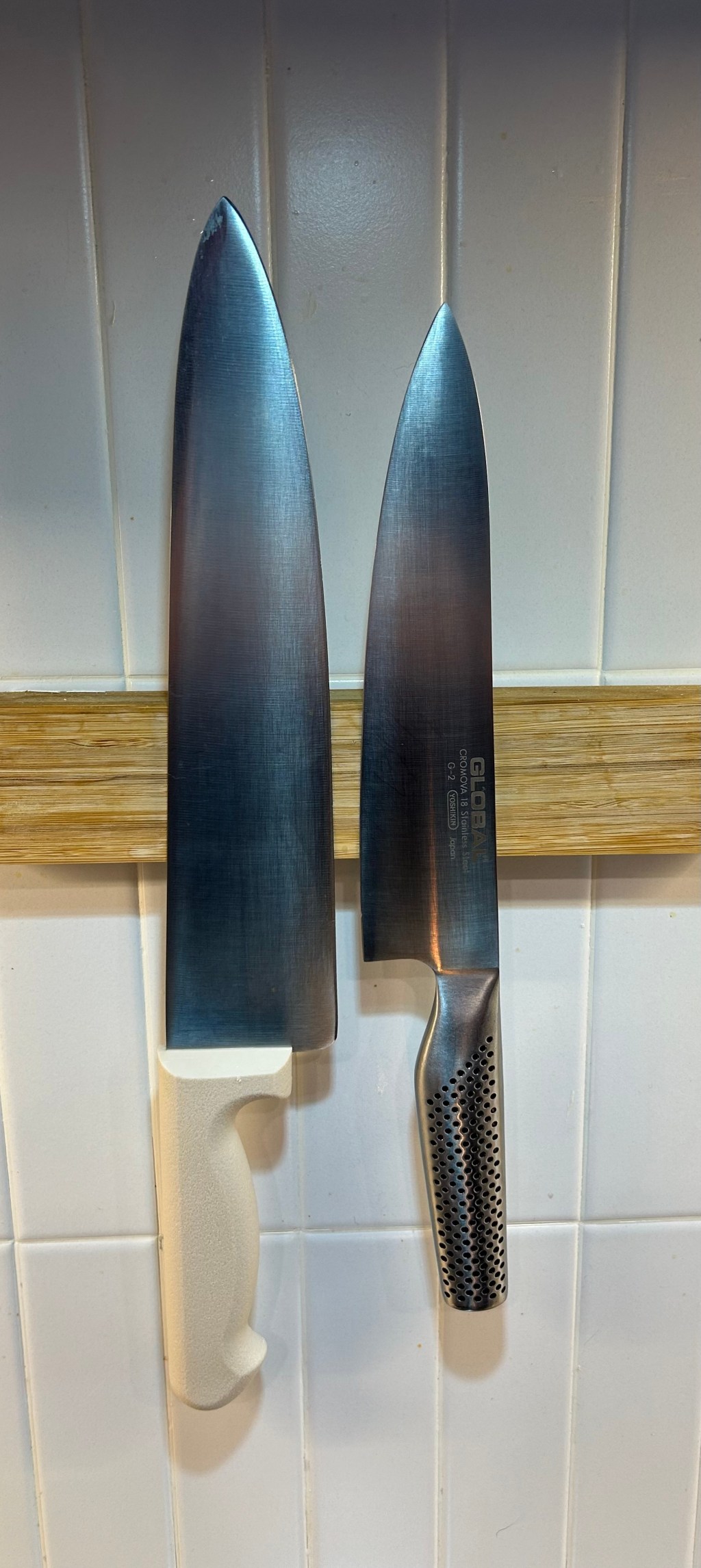
Learning to choose a knife in a silly kitchen.
Here is some knife talk, straight to the point (ha!), because choosing a knife can be daunting. I’ve been reading up on what the best knife types are for a little kitchen; – here are the absolute essentials when it comes to knife types.
First, there are two styles of knives; Western & Japanese.
A western blade has a more curved profile and is made of softer steel, making it ideal for a rolling cut motion. Due to their softness they are more durable, less prone to chips and can be used to cut harder items such as frozen foods or nuts. Western knives have edges at about 20 degrees, & are thus less “sharp” than Japanese knives (but still more than capable of any kitchen task)!
The softer steel used in western steel knives will dull faster than other metals, however the softer metal also allows for use of a honing rod in between sharpening. As a knife is used it’s edge is pushed to one side or another, creating a cutting edge that is skewed off center – this makes the knife cut less precise. Softer steel is forgiving enough to be “re-centered” with a honing rod without chipping the metal, which can help give your knife a quick improvement in between actual sharpening. Aesthetically, they have a more industrial look – with western style handles as seen in the pictures below.


Japanese knives are made of harder metals, such as carbon steel. This allows them to hold an edge for longer & be forged razor sharp. Harder metals are also more brittle, making chips to the blade more of a threat. The harder material also means that honing rods are not as effective, as they can chip your knife instead of realigning the edge.
Japanese knives are forged to about 15 degrees on average, allowing for extremely precise laser-like cuts. Japanese knives come in many, many styles – each designed for a different task. The most common daily driver kitchen knife styles are Gyuto, Bunka and Santoku (see graphic below). Nikiris are a common style used for vegetable prep. Because of the carbon content in many Japanese knives, they are prone to rusting if not properly cared for. However, if properly maintained they can develop a beautiful and unique protective patina. High end Japanese knives are often hand crafted by expert knife makers and can get pricey. (& people get serious about their collections – see here).


In general, the debate of western vs. japanese knives can be boiled down to precision vs. durability – which is a matter of personal preference. Japanese knives are works of expert craftsmanship that are extremely precise. However, they require more maintenance & are prone to chips and rust if not tended to. Western knives can handle any kitchen task without worry, but do not hold an edge for as long and may not offer the laser like edge of a Japanese knife.
In a silly little kitchen, both can be used to tackle any meal preparation. Although for a beginner, the durability and versatility of a western chef’s knife could give more confidence in wielding a blade, without worry of damaging your new tool.


 Silly little kitchen
Leave a comment